
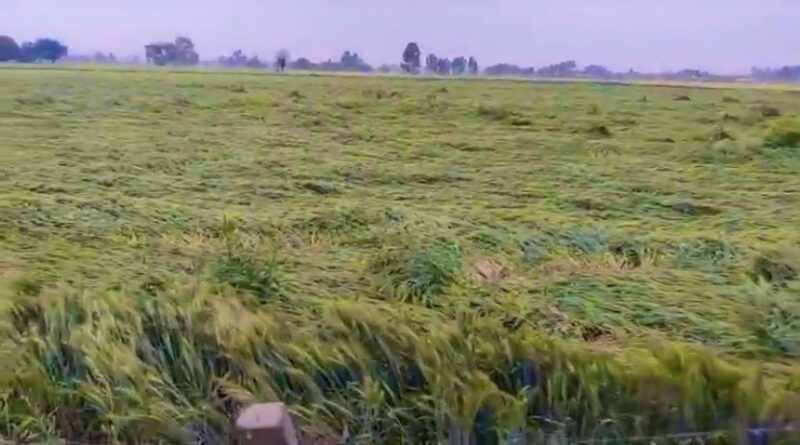
Rain damages wheat on 1.3L acres in Punjab, farmers stare at losses
By Ruchika Khanna
With untimely rain damaging standing wheat crop on 1.30 lakh acres in Punjab and increasing the grain’s moisture content above the procurement limit, harvesting in the state is expected to be delayed till after Baisakhi.
Though commission agents in the state on Wednesday “postponed” their protest and agreed to start procurement operations from Thursday, wheat is only trickling into the mandis. Till this evening, 11,984.99 metric tonnes (MT) of wheat had arrived in mandis, of which 7,693.80 MT has been procured. Normally, by this time, mandis begin to flood with grain. However, rain across Malwa, Majha and Doaba just before harvesting has led to harvesting delays and possible yield loss of 4-5 quintals per acre.
Talking to The Tribune, arhtiyas, traders and government officials said the wheat arriving in mandis had a moisture content of 14-16 per cent and could not be procured until it dried to the specified limit of 12 per cent. Raj Sood, a commission agent in Khanna, said even as they ended their protest, procurement could not begin till moisture levels came within the limit. “We are advising farmers to delay harvesting by a few days and bring only dry grain to mandis,” he said.
Farmers said that while moisture levels would drop with warmer days ahead, crop lodging caused by rain, hail and strong winds would result in significant yield losses. Kulwant Singh, a farmer from Kishangarh village in Mansa, said he now expected a yield of 20 quintals per acre, down from 25 quintals earlier. “Early varieties lost yield due to heat in late February, while late-sown wheat has suffered due to recent rains and winds,” he said, adding that his losses exceeded Rs 10,000 per acre.
Gurbakshish Singh, a farmer from Bimbar village near Nabha, said there was a need for a customised crop insurance policy. “Climate change is a major challenge for agriculture, and crop insurance is essential. But policies must be designed in consultation with farmers. The Centre’s ‘one size fits all’ approach, which does not consider per-acre assessment, needs to be revised,” he said.
This article has been republished from The Tribune.